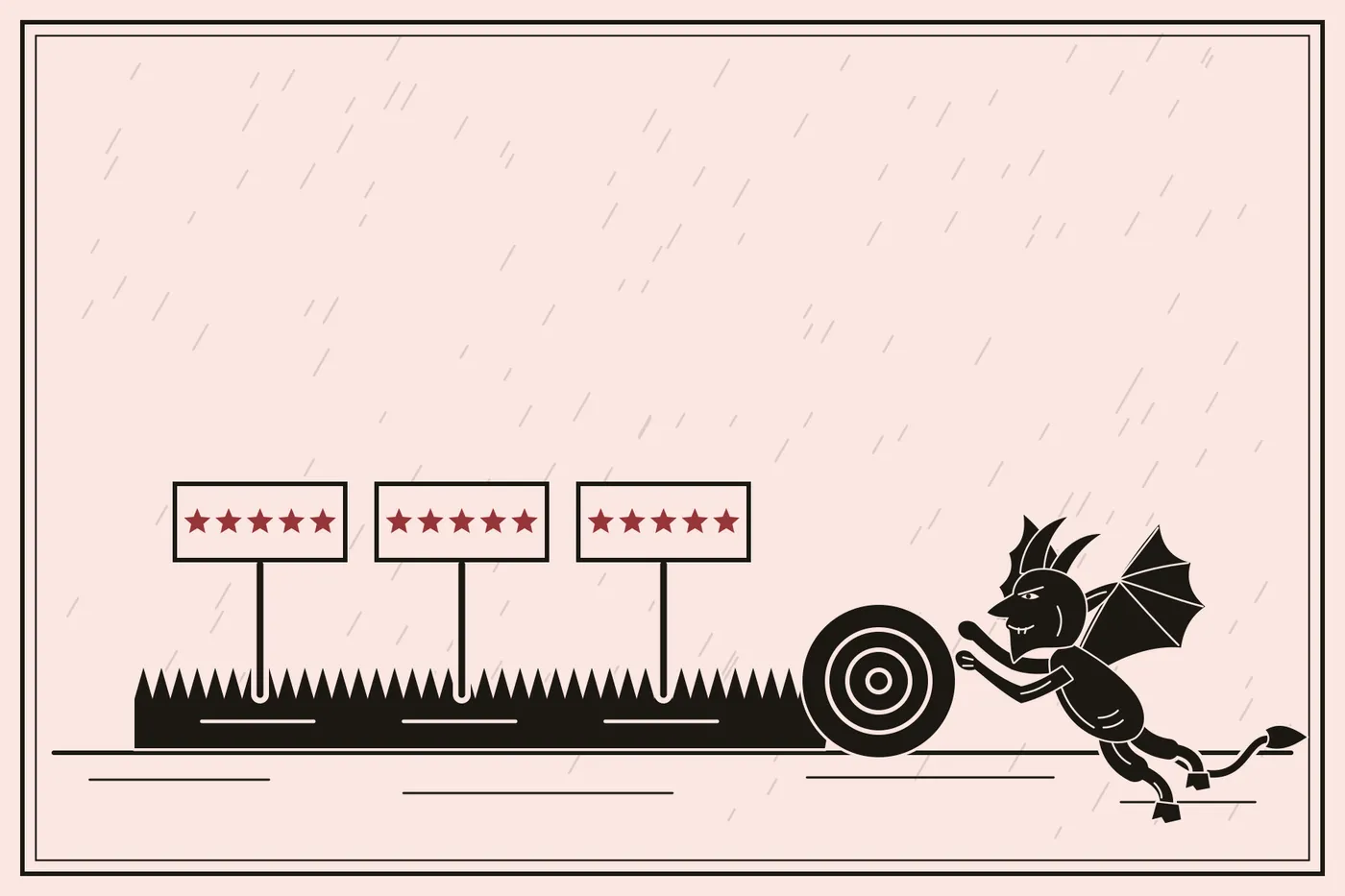
Astroturfing is fake grassroots: a campaign that hides who paid for it and dresses up as ordinary people. The five-star review written by the owner’s nephew is astroturf. So is the concerned citizen’s letter drafted by a lobbyist, and the thousand accounts that all happen to love the same crypto website. The astroturfing examples below run from a 1985 mailbag to a 2026 federal lawsuit, and they all have the same shape.
What changed is the price. Faking a crowd used to take postage, printing or a room full of people paid to type. Now it takes software and an afternoon, and the fakes are often better written than the real thing.
My view: the rules have finally caught up on paper, in Washington and in Brussels, and enforcement has started. The platforms that host the fakes have known about the problem for more than a decade, and every month of delay was a month in which fake reviews helped sell things they took a cut of.
What is astroturfing, and where does the word come from?
AstroTurf is a brand of artificial grass, developed at Monsanto and named after its famous installation in the Houston Astrodome in 1966 (AstroTurf). As a metaphor it is perfect: green, flat and grown by nobody.
The political meaning is usually credited to Lloyd Bentsen, then a senator from Texas. In 1985, faced with a flood of cards and letters that insurance companies had organized, he was quoted in The Washington Post saying that “a fellow from Texas can tell the difference between grass roots and AstroTurf” (Astroturfing). He called it generated mail, which is still the best two-word definition.
The difference from advertising is the signature. An ad tells you who is talking; astroturf removes the name and borrows the credibility of strangers. In Participation is not engagement I argued that likes and completes only prove that someone showed up. Astroturf is what you get when someone works out that it’s cheaper to fake the showing up.
Classic astroturfing examples, before AI
The old cases cost real money, and they left a paper trail. In 2006 a blog called Wal-Marting Across America followed “Jim and Laura,” a couple driving an RV across the country and chatting with cheerful Wal-Mart employees. BusinessWeek revealed that Wal-Mart was paying for the trip through Working Families for Wal-Mart, a group the company funded and its public relations firm Edelman organized. Edelman apologized and took the blame (NBC News).
In 2013 Taiwan’s Fair Trade Commission fined Samsung’s Taiwan subsidiary NT$10 million, about $340,000, for hiring students to post fake reviews attacking HTC’s phones (Fortune). The subsidiary had already admitted the scheme that April, so the only open question was the price.
The biggest case was a public consultation. When the Federal Communications Commission moved to repeal net neutrality rules in 2017, it received more than 22 million comments, and New York’s attorney general later concluded that nearly 18 million were fake (New York Attorney General). An industry coalition, Broadband for America, spent $4.2 million on a campaign that produced more than 8.5 million of them, in the names of real people who had never written a word (CBS News).
The investigators found no evidence that the broadband companies knew about the fraud, and three lead generators that did the work paid more than $4.4 million. The other side cheated too: most of 9.3 million fake comments in favor of net neutrality came from one 19-year-old college student with automated software.
Divide $4.2 million by 8.5 million and you get the 2017 price of a fake citizen. It was about 50 cents, and two years later a student showed it could be close to nothing.
How AI made fake reviews and bot armies cheap
In 2019 Max Weiss, then a Harvard undergraduate, wrote a bot that used a language model to write public comments on a Medicaid waiver for Idaho. In five days it submitted 1,001 comments, 55.3% of all the comments the proposal received, and people asked to pick out the fakes were right 49.63% of the time (Weiss, Technology Science). That is a coin toss. Weiss told the agency, and the comments were withdrawn.
In 2023 Kai-Cheng Yang and Filippo Menczer searched Twitter for “as an AI language model,” the boilerplate a chatbot produces when it declines a request. They found a network of 1,140 accounts that posted machine-written text and stolen photos, mostly about cryptocurrency, and retweeted each other to look popular (Yang and Menczer). Detectors of machine-written text couldn’t tell the accounts from humans. Their coordination gave them away.
Professionals were already working at scale. In May 2024 Meta removed 510 Facebook accounts, 11 pages, one group and 32 Instagram accounts run by STOIC, a political marketing firm in Tel Aviv, whose fake users posed as American and Canadian citizens (Arab News). In July 2024 the US Justice Department seized two domains and searched 968 accounts on X belonging to an AI-enhanced bot farm, which prosecutors tied to a senior employee of the Russian broadcaster RT and said the Kremlin had approved and funded (Justice Department, Al Jazeera).
Reviews followed the same curve. One of the largest travel review platforms says it removed 214,000 AI-generated reviews in 2024, out of 2.7 million it classed as fraudulent (transparency report). In two experiments published in Marketing Letters in 2024, Balázs Kovács found that people cannot recognize machine-written reviews, even when paid for accuracy, and that the detectors were fooled as well (Kovács, 2024).
What does the FTC fake review rule ban?
Before 2024 the FTC fought fake reviews with its general ban on deception, and its remedies were mild. In October 2019 it settled with the skincare company Sunday Riley, whose managers, including the founder, had posted reviews on Sephora’s website from fake accounts for almost two years. The order told them to stop and required no payment, and two of the five commissioners voted against it (FTC). In 2021 the Supreme Court ruled unanimously that the agency couldn’t use Section 13(b) of the FTC Act to make wrongdoers pay money back (AMG Capital Management v. FTC).
The new rule was announced on August 14, 2024, by a 5-0 vote, and took effect on October 21, 2024 (FTC, Federal Register). It bans:
- writing, buying or selling fake reviews and testimonials, including ones attributed to people who don’t exist, which the FTC tied explicitly to AI-generated fakes,
- paying for reviews on condition that they are positive, or negative,
- reviews by owners, managers and employees that don’t disclose the connection,
- company-controlled review sites that pose as independent,
- suppressing negative reviews with threats, intimidation or false accusations,
- buying or selling fake followers and views, generated by bots or hijacked accounts, to look influential for a commercial purpose.
What changed is the price of getting caught. Knowing violators face civil penalties of up to $53,088 per violation, and in December 2025 the FTC sent warning letters to 10 companies (FTC). In April 2026 it charged TruHeight, a seller of supplements for children’s height, with publishing several thousand five-star reviews written by its own employees and running bot profiles that posted software-generated comments on its Facebook and Instagram pages (FTC). The final order came with a $4 million judgment, partly suspended after a payment of $750,000 (FTC).
In May 2026 the Justice Department, acting for the FTC, and the state of Illinois sued a home repair referral business that allegedly created more than 15,000 fake business profiles on Google Search and Maps and propped them up with fake reviews (Justice Department). That case is pending.
What do the EU and UK rules say about fake reviews?
The EU got there first. Directive (EU) 2019/2161, applied since May 28, 2022, added two items to the blacklist of the Unfair Commercial Practices Directive, the practices banned in all circumstances (EUR-Lex). One bans claiming that reviews come from people who used or bought the product without taking reasonable and proportionate steps to check. The other bans submitting or commissioning false reviews, or misrepresenting reviews and social endorsements.
A site that shows reviews must also say whether and how it checks them, and for widespread cross-border infringements the maximum fine must be at least 4% of annual turnover in the countries concerned. When consumer authorities from 26 member states, Iceland and Norway screened 223 major websites in January 2022, at least 55% potentially broke the law, and 144 couldn’t show they did enough to make sure reviews came from real customers (European Commission).
The UK followed with the Digital Markets, Competition and Consumers Act 2024. Since April 2025 fake reviews and unlabeled paid reviews have been banned practices, the Competition and Markets Authority can fine a business up to 10% of global turnover, and in March 2026 it opened investigations into five businesses over their reviews (CMA).
Do the platforms profit from fake reviews?
The platforms deserve a fair hearing first. Amazon says it blocked more than 275 million suspected fake reviews in 2024 and sues the brokers who sell them (Amazon). Google says it blocked or removed more than 240 million policy-violating reviews of places and businesses that year (Google). Companies doing nothing don’t publish numbers like that.
They are, however, grading their own homework, and the timing matters more than the totals. Sherry He, Brett Hollenbeck and Davide Proserpio followed about 1,500 Amazon products whose sellers recruited fake reviewers in private Facebook groups in 2019 and 2020 (He, Hollenbeck and Proserpio, 2022). Facebook deleted groups now and then, and they quickly reappeared. Amazon eventually deleted a large share of these products’ reviews, but on average more than 100 days after they were posted, while the median campaign lasted six days.
Sales rose during the campaigns. When they ended, ratings fell and the share of one-star reviews rose from about 8.5% to more than 13%, which means buyers paid for the lag.
Regulators had to push, repeatedly. Facebook promised the CMA in January 2020 to deal with fake review groups, the trade carried on, and after a second intervention it removed another 16,000 groups in April 2021 (CMA). The CMA opened its investigation of Amazon and Google in 2021, and it took until 2025 for both to sign undertakings to detect fakes faster and sanction the businesses that buy them (CMA).
Here is my opinion, labeled as one. Every fake review that helps sell something also helps the platform that hosts it, through a commission, an ad or simply traffic, while the cost lands on the buyer and on the honest competitor. Nobody has to plan to profit from fakes; it is enough to be in no hurry. The new rules matter because they move the cost of that delay onto someone who can do something about it.
How to tell if reviews are fake
No single check is reliable, but together these catch most of the cheap stuff:
- Check the dates. The FTC’s first tip is to watch for a burst of reviews over a short period (FTC).
- Click on the reviewer. An account that exists for one glowing review is a warning sign.
- Sort by newest. A wave of five-star reviews followed weeks later by a wave of one-star reviews is exactly the pattern the Amazon study found.
- Don’t treat “verified purchase” as proof. The fake review groups had people buy the product and refunded them afterwards.
- Don’t trust your ear for prose. Fluent, warm, specific text is no longer evidence of a human.
- With crowds of accounts, look at the crowd: identical phrasing, the same links, new accounts boosting each other.
The same habit works beyond shopping. When a politician or a press release cites a flood of public comments, the first question is who sent them.
My take
Astroturf has always counterfeited the cheapest signal there is. Participation was easy to fake when it took postage, and now it takes nothing. Once star ratings became the number that decides what sells, they became a target, and as Goodhart’s law predicts, a target stops being a good measure.
The worst damage isn’t the money lost on a miracle supplement or a phantom plumber. It’s that fakes teach everyone to discount all reviews, including the honest ones from people who took ten minutes to warn a stranger.
I think the rules are now good enough on paper: the FTC’s list is specific, the EU blacklist is blunt and the UK can fine by turnover. What’s missing is enforcement at the speed of the fakes, and platforms that pay for the fakes they leave up. A fake review shares the flaw of ads that treat customers like idiots: it assumes nobody will check. More people are checking now, and some of them work for regulators.
Questions people ask
What is astroturfing?
Astroturfing is a campaign that hides who is behind it and pretends to come from ordinary people: fake reviews, organized letter campaigns, sock-puppet accounts and bot networks. The word plays on AstroTurf, a brand of artificial grass, as the fake opposite of grassroots.
Where does the word astroturfing come from?
It is usually credited to Senator Lloyd Bentsen of Texas. In 1985 he dismissed a pile of industry-organized mail by saying that a fellow from Texas can tell the difference between grass roots and AstroTurf.
Are fake reviews illegal?
In the US, the FTC’s rule on consumer reviews and testimonials has banned fake and bought reviews since October 21, 2024, with civil penalties of up to $53,088 per violation. In the EU, fake reviews have been on the blacklist of unfair commercial practices since May 28, 2022, and the UK banned them in April 2025.
How can you tell if online reviews are fake?
Look for bursts of reviews over a few days, reviewers with no other history and a wave of one-star reviews a few weeks after a wave of five-star ones. Don’t rely on the writing style: in experiments, people can no longer tell machine-written reviews from human ones.